President's Fact Book Revised and Updated!: The Achievements, Campaigns, Events, Triumphs, and Legacies of Every President from George Washington to Barack Obama by Matuz Roger
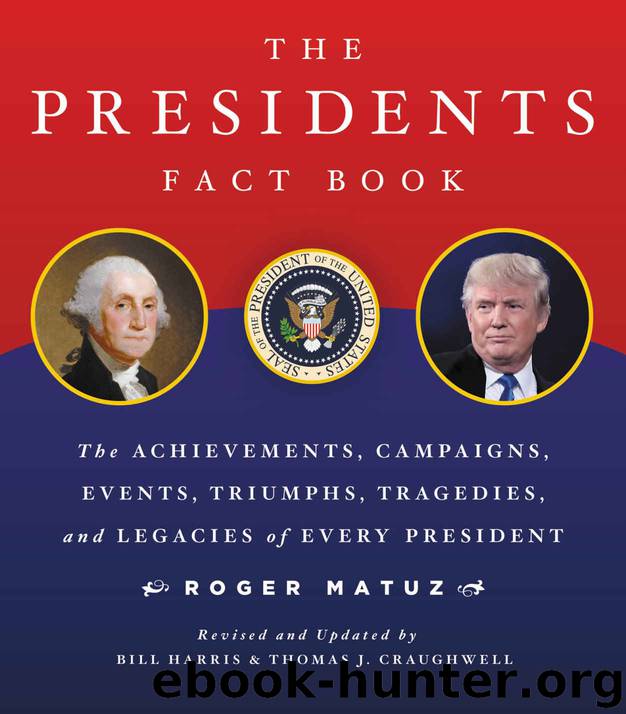
Author:Matuz, Roger
Language: eng
Format: epub
Publisher: Running Press
Published: 2017-01-03T05:00:00+00:00
Oliver Wendell Holmes Jr.
Oliver Wendell Holmes Jr. was born in Boston, Massachusetts, on March 8, 1841. At the age of sixteen, he began attending Harvard University, where he wrote articles for student publications and complained of the school’s unwillingness to accept new ideas. One such idea was the theory of evolution, first published in 1859 by English naturalist Charles Darwin. Holmes was fascinated by the scientific reasoning Darwin had used to arrive at his idea that humans and other animals had evolved from earlier forms of life.
Holmes served in the Civil War for three years before enrolling at Harvard Law School in 1864. Two years later, he began his career as a lawyer and he also wrote and taught law. In 1881, he published The Common Law, arguing strongly that laws should not be unchanging rules simply passed on from generation to generation, but should change and develop along with the changing times. Holmes thus applied Darwin’s ideas to the history of law.
In 1882, he was named to the Massachusetts Supreme Court in 1882, and served there for twenty years. In the late 1800s, the nation began facing increasing tensions between workers and their employers, resulting from growth brought about by the Industrial Revolution, as large corporations with thousands of employees sprang up for the first time. Following Holmes’s theories in The Common Law, new laws had to be made and old laws had to be interpreted in new ways.
President Theodore Roosevelt named Holmes to the U.S. Supreme Court in 1902, believing that he would support his political goals. In particular, Roosevelt was “trust-busting”—trying to break up large corporations that held monopolies and were controlling important industries. In Massachusetts, some of Holmes’s opinions seemed sympathetic to Roosevelt’s aims. But in Holmes’s first trust-busting case as a Supreme Court justice, he angered Roosevelt by disagreeing with him. Holmes insisted on judging each case by his own standards, rather than by anyone’s political goals.
Holmes’s independent views and his eloquent language led to his being called the “Great Dissenter.” The fact was, though, that his dissents only amounted to about 3 percent of the cases he heard. But his elegant writing style and clear logic made his opinions stand out more than those of other justices. In Lochner v. New York (1905), for example, the Court declared unconstitutional a New York law establishing a sixty-hour workweek for bakers, saying that it limited the economic freedom of bakery owners. Remaining true to his idea of a living law that changes to follow the needs of society, Holmes wrote that the Constitution is not intended to embody a particular economic theory but to defend the rights of people with widely differing views.
When the United States entered World War I in 1917, Congress passed laws to prevent antiwar activists from spreading their views, which were thought to be dangerous to the war effort. The Federal Espionage Act of 1917 established stiff penalties for interfering with recruiting efforts. An amendment to the act also set penalties for
Download
This site does not store any files on its server. We only index and link to content provided by other sites. Please contact the content providers to delete copyright contents if any and email us, we'll remove relevant links or contents immediately.
Fanny Burney by Claire Harman(26591)
Empire of the Sikhs by Patwant Singh(23069)
Out of India by Michael Foss(16842)
Leonardo da Vinci by Walter Isaacson(13306)
Small Great Things by Jodi Picoult(7112)
The Six Wives Of Henry VIII (WOMEN IN HISTORY) by Fraser Antonia(5493)
The Wind in My Hair by Masih Alinejad(5085)
A Higher Loyalty: Truth, Lies, and Leadership by James Comey(4946)
The Crown by Robert Lacey(4802)
The Lonely City by Olivia Laing(4796)
Millionaire: The Philanderer, Gambler, and Duelist Who Invented Modern Finance by Janet Gleeson(4457)
The Iron Duke by The Iron Duke(4345)
Papillon (English) by Henri Charrière(4251)
Sticky Fingers by Joe Hagan(4185)
Joan of Arc by Mary Gordon(4092)
Alive: The Story of the Andes Survivors by Piers Paul Read(4017)
Stalin by Stephen Kotkin(3955)
Aleister Crowley: The Biography by Tobias Churton(3628)
Ants Among Elephants by Sujatha Gidla(3459)
